Coín, Málaga
Bosque Humano
The land in Coín where Seth developed and tested the Permasesor method, with the Bosque Humano association. The full design went in over six months in 2022, partly subsidised by the Junta de Andalucía.
2 ha
2022
Want the same on your land? See the Full Regeneration Programme.
Before
Before the design, the land suffered erosion and an avocado monoculture, which Seth compares to a desert: stop watering the avocados and everything dies. Water was over-used, and rain ran off instead of soaking in. Bosque Humano now works across 20,000 m², part of it neighbouring land that shares the project’s aims.
Location
Coín, Málaga
Size
2 ha
Dates
2022
Status
Full design since 2022, after 15+ years of small-scale tests
Objectives
Six objectives for the land
01
Grow topsoil.
02
Reduce irrigation requirements.
03
Establish forest canopy above 12 m.
04
Grow a human-based ecosystem.
05
Eliminate erosion and erosion-prone landforms.
06
Capture and infiltrate 100% of incidental rain, while managing overflow from upslope properties in flood scenarios.
Swale profile

Food-forest strata, up to 20 m
Method
Five installation layers
Seth draws every project in five layers: information, earthworks, infrastructure, vegetation and functionality. At Bosque Humano, earthworks began in March 2022, intensive planting ran from April to June and the irrigation was finished in June.
The built elements include La Ecocasita, an eco-cabin with greywater treatment and a compost toilet. Seth checks the soil by eye, and it now holds more organic matter and more invertebrates.
Drawings: Seth Andrew Thompson
Build order
What Seth built at Bosque Humano, in the order he built it.
01
House
02
Workshop
03
Kitchen
04
Green roof
05
Greywater system
06
Dry toilet
07
Lower gully dam
08
New irrigation system
09
Nursery
10
Upper gully dam
11
Swales
12
Diversion drains
13
Upper and lower ridge dams
14
Guest cabin (wood)
15
Green roof (guest cabin)
16
Volunteer cabin (cob)
17
Guest cabin greywater
18
Banana shower
19
Photovoltaic installation
20
Greenhouse
21
Volunteer chambao (open-air hut)
Results, one season
What one season yields
In one season: 3,000+ kg of mangos, 300 kg of lychees, 2,000+ kg of mixed vegetables, 200+ kg of mulberries, 500+ kg of grapes and more than 100 species of medicinal plants.
01
18,000 m²
Earthworks
Four dams holding 240,000 litres between them, 60 m of swales, 170 m of diversion drains and 430 m of access. Cost: €1.11/m².
02
14,000 m²
Irrigation
A new 8-sector system replaced the old one, which had decaying tubes and inefficient filtering. The water concession is 6,000 m³ a year and use after installation is 4,612 m³, 23% less. Cost: €1.60/m².
03
20,000 m²
Vegetation
More than 163 species and more than 15,000 plants, 75% irrigated and 25% dry-land. The objective is a canopy above 12 m. Cost: €2.30/m².
Before and after
Erosion remediation
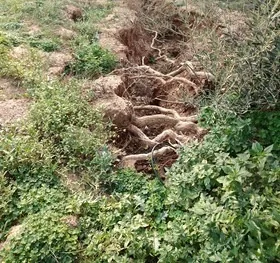
Before
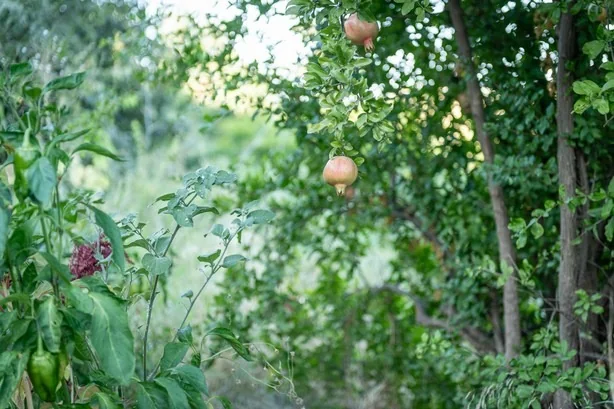
After
Infiltration swale
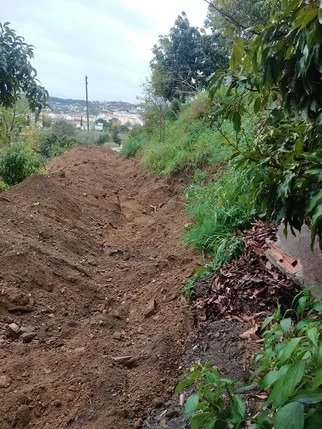
Before
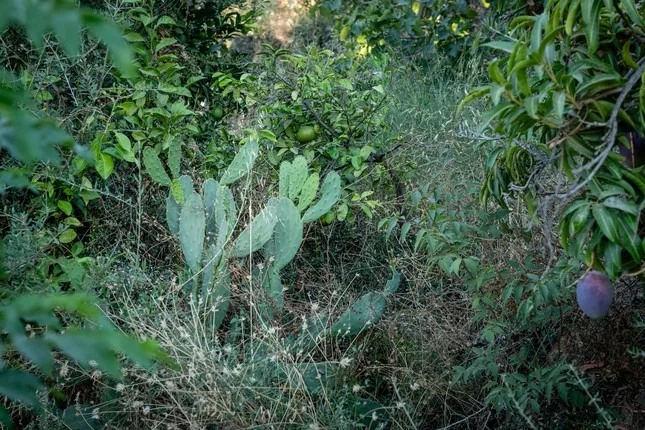
After
Bare land remediation
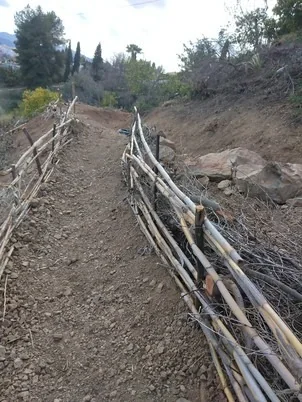
Before
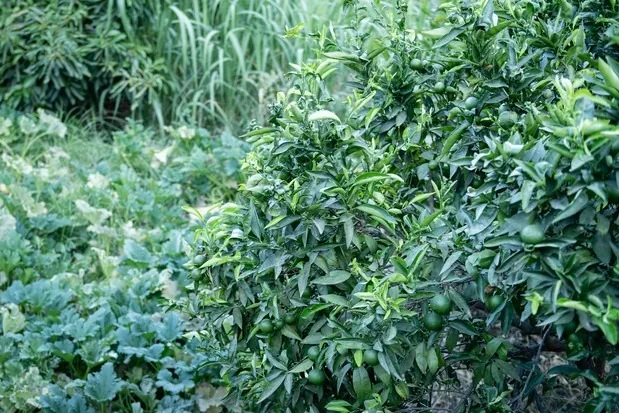
After
Finished dams
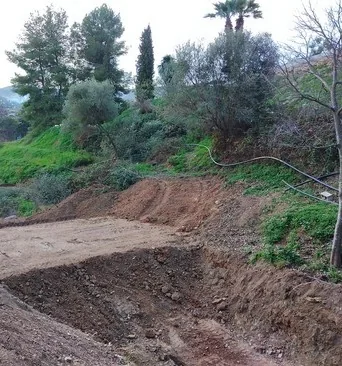
Before
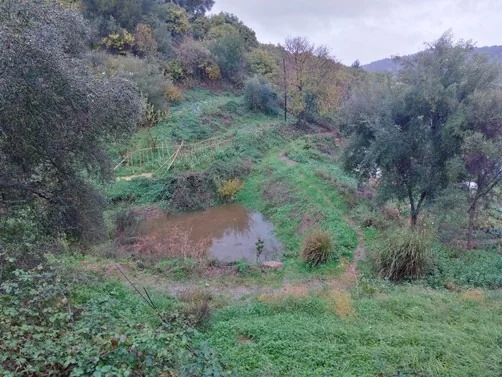
After
Cost
What it cost
Administration
€4,130
4.5%
Design
€11,412
12.3%
Project management
€13,880
15.0%
Labour and subcontracting
€26,393
28.5%
Materials and plants
€36,760
39.7%
Total, no VAT
€92,575
€4.63/m²
Administration: licensing and permissions €1,200, preparation of documentation €1,030 and administration of subsidies €1,900.
This is what this project actually cost, with volunteer labour and a Junta de Andalucía subsidy. It is not a market rate and not a guide to pricing another site.
Licensing and documentation
As an agricultural installation in a non-protected area, this project required simple licensing. In a protected area, or on another site, the situation can differ.
Documentation: IFAPA “Creación de Empresa Agraria” training accreditation, direct sales registration, REAFA inscription, Social Security and organic production certification.
Take-aways
Three take-aways
01
The cost of this project was greatly reduced by the helping hands of many volunteers.
02
The four following years after this implementation saw exponential growth in vegetation. But there is constant maintenance, and the systems need to be attended to and assisted through pruning and successive deposition of the pruned material.
03
This project attracts many interested people, who also want to do or learn about the same kind of activity.
“A human-plant symbiont is a plant species which has a direct metabolic connection available to our species. This human-plant symbiotic requirement is what distinguishes Permasesor as an innovator in the field. After 25 years of research, the author has come to a synthesis and expertise in the creation of resilient biological systems.”
Seth Andrew Thompson
